

Most people are, euphemistically speaking, economical with software requirements.
Clients, users, product owners, team leaders, and other ticket-writers typically don’t obsess about details. While laziness and knowledge gaps play their role, it also happens due to implicit expectations.
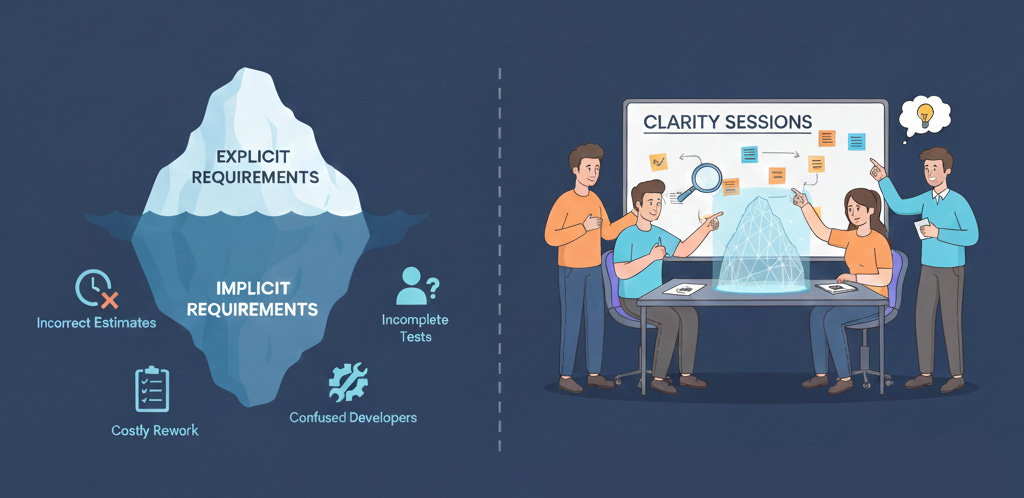
Implicit requirements are unstated, but expected, features or characteristics, that are so fundamental they are not written down or discussed. For instance, a client asking for a mobile app most likely expects to find it in the app store, a ticket for dark theme support might imply automatic switching based on system preferences, or a request for multi-factor authentication might imply an admin area to restore access for users who lost their phone.
The trouble is, of course, that people don’t share a common mind. And while idea-makers can live in a fuzzy world, developers don’t have that luxury. Regardless of seniority, developers require clearer specifications on of what needs to be done.
Every time you accept a feature request or a ticket, either for yourself or for your team, it makes sense to stop and identify implicit requirements. Similarly, it is important to do the same when creating work for others.
Assumed requirements are a liability. They lead to:
Inaccurate estimates
Invisible scope creep
"guess-driven development"
Testing gaps
Ultimately, implicit requirements result in costly rework that leaves everyone unhappy.
So be cautious, ask more questions, and develop that product and industry intuition over time. It also works better with more people, so include others. If you are doing something like refinement sessions, invite testers and support folks too. The result will be the best, as nobody will have to guess anymore.
When you eliminate the guesswork, you eliminate the risk.
PF 2026
—Petr